
Mobile
App Core Features Objectives: What to Build First
Connect app core features objectives to measurable user outcomes, define your scope, and choose what to build first for a useful mobile app.
Also available in: Español, Français, Deutsch, Português (Brasil), Italiano, Nederlands, हिन्दी, 日本語, 한국어, 简体中文
On this page
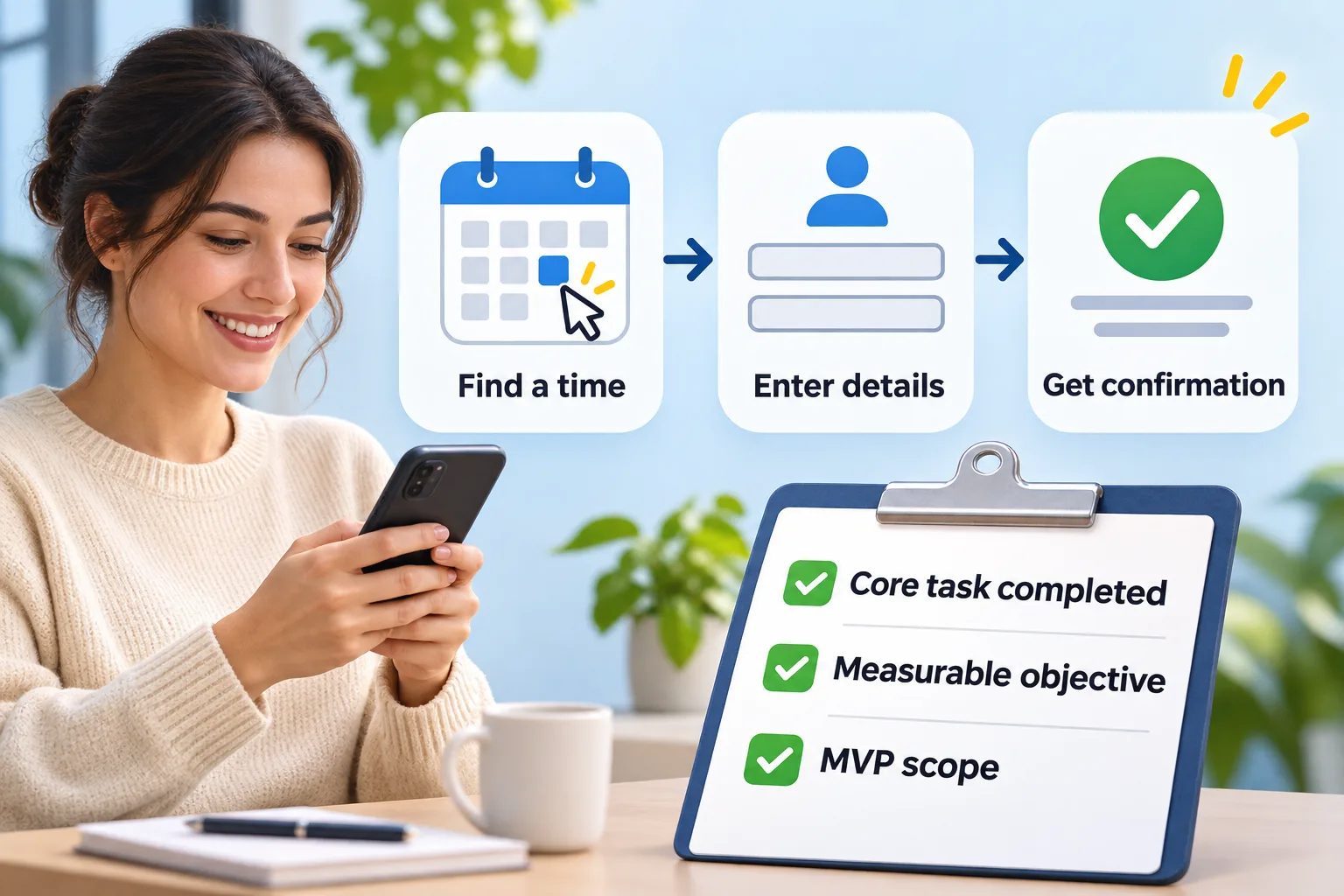
App core features objectives should connect every proposed feature to a measurable user outcome. Build the smallest release that lets your target user finish the central task, such as booking an appointment and receiving confirmation. Choose features by their contribution to that outcome, then define the scope before development starts.
What are app core features and objectives?
App core features objectives connect what users can do with the outcome you want them to achieve. An objective is a desired outcome, such as completing an appointment booking without calling your office. A feature enables a user action, such as choosing an available time. A metric measures the outcome, such as the percentage of booking attempts that reach confirmation.
Your main app features should complete that central task. There’s no universal list of basic app features: a booking app may need appointment availability, while a field-reporting app needs report submission. Keep a feature when the intended task depends on it.
What do you need before choosing app features?
You need a defined user problem and delivery limits before choosing features. Gather enough detail to explain where the current process fails and what the first release must accomplish.
- Name the target user, such as a patient booking a follow-up.
- Gather problem evidence, such as requests for help with booking.
- Describe the current workflow from request to confirmed appointment.
- Set a budget that covers the build and ongoing operation.
- Name the deadline and the reason behind it.
- Choose the required platforms, such as iOS and Android.
Design, testing and support needs matter more than feature count when defining mobile app scope. One calendar integration needs investigation before you can estimate it. AppDesign360’s mobile builds start at $3,500 for an agreed starter scope, with features, platforms, price and timing confirmed in writing.
How do you turn an app idea into a measurable objective?
Turn your idea into an objective by naming the user, desired outcome, starting measure, target and deadline. The starting measure is your baseline: how well the task works now. If you don’t know it, measure the existing process before promising an improvement.
For a hypothetical clinic, the objective could be: “Help returning patients increase booking completion from 60% to 75% within 90 days of launch.” Define completion as confirmed bookings divided by booking attempts, using the same definition throughout. These figures illustrate a goal, not a forecast.
- Show available appointments for the selected service.
- Let the patient choose a suitable time.
- Collect the details needed to reserve the appointment.
- Confirm the reservation and show what happens next.
This sequence gives each proposed feature a purpose. Patient value is a confirmed appointment without extra help; business revenue is a separate result to track. If patients abandon the details form, investigate that step before adding features unrelated to booking completion.
Which app key features belong in the first release?
Include the features needed to complete the main task, plus the safeguards that make that task dependable. For the hypothetical clinic, patients need to find an appointment, reserve it and receive confirmation. Treat every additional feature as a proposal that needs a reason, not a basic requirement.
Accounts belong in the first release if patients need protected access to booking history or appointment management. Payments belong there if a deposit or payment is required to secure the appointment. Reminders belong there if helping patients attend is part of the launch objective; otherwise, consider them after booking works.
Accessibility, security and reliability are quality requirements, not optional extras competing with booking features. Accessibility means people with disabilities can complete the task, such as choosing a slot with a screen reader. Security means protecting patient information and restricting access; reliability means a confirmed booking is actually saved. Write checks for these requirements into the scope rather than treating a working screen as proof that the task works.
| User task | Feature | Objective | Success measure | First-release or later status |
|---|---|---|---|---|
| Find an appointment | Available appointment slots | Find a suitable time | Booking attempts reaching slot selection | First release |
| Reserve the slot | Required-details form and reservation | Secure the chosen appointment | Valid submissions producing a saved reservation | First release |
| Know the booking succeeded | Confirmation with appointment details | Remove uncertainty after submission | Saved bookings with matching confirmation | First release |
| Manage an existing appointment | Account and booking history | Change bookings without staff help | Changes completed without assistance | Later unless self-service changes are a launch objective |
| Pay a required deposit | Payment during booking | Meet the clinic's reservation policy | Successful deposits linked to confirmed bookings | First release only if a deposit is required |
| Remember the appointment | Appointment reminder | Support attendance | Attendance among booked patients | Later unless attendance is a launch objective |
How do you prioritize features and define mobile app scope?
Prioritize the smallest complete journey, then define what counts as working before development starts. A minimum viable product, or MVP, is the smallest release that delivers the core outcome and tests your assumptions. For the clinic, that assumption might be that patients can book without calling staff.
Assess user value alongside effort, dependencies and risk. A dependency is something a feature needs to work, such as access to the clinic's scheduling system. The table identifies work to investigate, not fixed estimates: an existing scheduling connection changes the effort involved.
| Booking feature | User value | Effort to investigate | Dependencies | Risk to test |
|---|---|---|---|---|
| Live appointment availability | Shows times patients can reserve | Connecting and updating the schedule | Access to the scheduling system | An unavailable slot remains visible |
| Reservation and confirmation | Completes the booking task | Saving bookings and handling failures | Availability and reservation rules | Confirmation appears without a saved booking |
| Online deposit | Secures a slot when payment is required | Payment processing and refund handling | Payment provider and clinic policy | Payment succeeds but booking fails |
| Appointment reminders | Helps patients remember their visit | Scheduling messages and handling changes | Contact details and messaging service | A reminder uses outdated appointment details |
Turn these decisions into mobile app scope with explicit boundaries. Acceptance criteria are observable conditions a feature must meet before you accept it. Use the booking journey to write those conditions, including what happens when something fails.
- Name the included journey, from viewing available appointments through receiving confirmation, and specify the supported platforms.
- List exclusions, such as loyalty rewards or reminders, so nobody assumes they are included.
- Require a test booking to appear in the clinic's schedule and show the patient matching appointment details.
- Require an unavailable slot or failed save to produce a clear recovery path without displaying a false confirmation.
How do you prevent feature creep and measure success?
Prevent feature creep by treating each addition as a scope decision, not a free improvement. Feature creep means adding work without revisiting scope, budget or timing. Copying a competitor's features or adding artificial intelligence (AI) without a defined user need gives you no clear basis for accepting that extra work.
If the clinic requests reminders during development, ask whether attendance is now a launch objective. Then agree to defer reminders, remove other work or revise the budget and date. Judge the release by completed bookings and where attempts fail, rather than downloads alone. Track repeat booking only when patients actually need another appointment; frequent app use isn't a useful goal for someone who needs care occasionally.
How can AppDesign360 help you scope your first build?
AppDesign360 can turn your app core features objectives into a build plan you can review before committing to development. Our separate App Blueprint starts at $1,250 and includes a clickable prototype, a technical specification and a build quote. The prototype lets you try the proposed screens; the specification describes how the app should work.
For a clinic, that could mean testing the path from appointment availability to confirmation before adding reminders. Use that review to identify missing decisions, such as who can cancel a booking. The right scope depends on the workflow, the data involved and any existing systems the app must connect to.
We agree on scope, price and launch date in writing before work starts, with ownership and handover defined. You keep your code, hosting and accounts. Our services have separate scopes, so an app build doesn't automatically include marketing or AI work.
| AppDesign360 service or business detail | Published terms and coverage |
|---|---|
| Business identity | AppDesign360 is the website, software as a service (SaaS) and custom software engineering brand of Mango Consulting LLC, founded in 2018. |
| Certification and clients | Mango Consulting LLC is an SBA-certified Service-Disabled Veteran-Owned Small Business (SDVOSB). We serve small and growing businesses, founders and nonprofits, and take on federal set-aside work. |
| Locations and delivery | Our local team is in Teaneck, NJ and Queens, NY. We serve North Bergen, NJ, Bergen County and New York City, with remote delivery across the United States and Canada. |
| Business websites | Custom-coded websites rather than templates, from $1,500. |
| SaaS product design and development | Software delivered as an online service, with a Blueprint from $1,250 and a minimum viable product (MVP) from $15,000. |
| Mobile app development | iOS and Android development, with App Store and Google Play submission. |
| Custom software | Business software and client portals, scoped to your workflow. |
| AI-built app review | Review, completion and launch help for existing AI-built apps. |
| AI engineering | AI solutions, large language model (LLM) integrations and automation. |
| AI consulting and coaching | Sessions from $125 to $250; implementation is scoped separately. |
| Specialist AI setup | Healthcare and Health Insurance Portability and Accountability Act (HIPAA) AI setup, plus open source AI setup sessions. |
| IT staff augmentation | Additional technical staff from $20/hour. |
| Search and AI visibility | Search engine optimization (SEO), answer engine optimization (AEO), AI optimization (AIO) and generative engine optimization (GEO), from $500/month. |
| Paid advertising | Google, Meta or Bing ads management from $300/month per platform, with ad spend additional. |
| Google Local Services Ads | Management from $599/month for eligible businesses, plus platform charges. |
| Ownership and support | Client-owned code, hosting and accounts, with defined handover. Support is available from the team that built it, including 30 days of fixes on new builds. |
To discuss your first build, book a free 20-minute discovery call at https://appdesign360.com/contact. Bring your main user task and any existing prototype; technical specifications aren't required.
What else should you know before building a mobile app?
Choose features by the user outcome they support, then set a separate business measure. For a booking app, a confirmed appointment shows task completion; revenue per completed booking measures commercial value. You need both if the app must earn money.
Key Takeaways
- •Build the smallest release that completes the main user task.
- •Give each proposed feature a measurable objective before adding it to scope.
- •Define acceptance checks and ownership before development starts.
- •Treat new requests as budget and timing decisions.
What makes a good mobile app?
What are the common features of mobile apps?
Are there goals related to monetizing the app?
Start a free project conversation about a website, software, app or marketing.
Discuss Your Project
Comments